Showing posts with label wetland birds. Show all posts

Common Greenshank (Tringa nebularia): Taxonomy, Identification, Ecology and Occurrence at Mahanadi River at Cuttack, Odisha,

 Common Greenshank (Tringa nebularia): Taxonomy, Identification, Ecology and Occurrence at Chilika Lake, Odisha

Abstract

The Common Greenshank (Tringa nebularia) is a widespread Palearctic migratory shorebird belonging to the family Scolopacidae. It breeds in the boreal and subarctic wetlands of northern Europe and Asia and winters across Africa, southern Asia, Southeast Asia, and Australasia. During the non-breeding season, the species frequents a wide variety of freshwater and coastal wetlands. The present note documents an individual observed along the Mahanadi River at Cuttack, Odisha, during April. Morphological characteristics visible in the photographs—including the long, slightly upcurved bill, greenish legs, robust body structure, and non-breeding plumage—confirm its identity as the Common Greenshank. This account reviews the species' taxonomy, recent systematic position, identification, ecology, migration, and significance within the freshwater riverine ecosystem of eastern India.


Introduction

The Mahanadi River is one of eastern India's major river systems and supports an extensive mosaic of sandbars, shallow channels, exposed mudflats, and seasonally inundated islands. These habitats provide important feeding and resting grounds for numerous migratory waterbirds arriving from northern Eurasia during the winter months.

Although Odisha is internationally recognized for the avian diversity of Chilika Lake, the riverine wetlands of the Mahanadi basin also constitute significant habitats for migratory shorebirds. Species of the family Scolopacidae, particularly members of the genus Tringa, regularly utilize these inland freshwater environments during migration and winter. Among them, the Common Greenshank (Tringa nebularia) is one of the largest and most conspicuous waders encountered on river sandbars and shallow margins.

The individual documented here was photographed standing in shallow flowing water on the Mahanadi River near Cuttack during April, representing a late spring migrant prior to its northward departure.

Tringa nebularia from Odisha observed April 2025


Taxonomic Classification

Kingdom: Animalia

Phylum: Chordata

Class: Aves

Clade: Neoaves

Order: Charadriiformes

Suborder: Scolopaci

Family: Scolopacidae

Subfamily: Tringinae

Genus: Tringa

Species: Tringa nebularia (Gunnerus, 1767)


Recent Systematic Position

The systematic arrangement of shorebirds has undergone considerable revision over the past two decades due to advances in molecular phylogenetics.

Earlier classifications were primarily based on external morphology, skeletal anatomy, plumage, and feeding behavior. Under these traditional systems, the Common Greenshank was placed within the genus Tringa along with shanks, tattlers, and yellowlegs.

Recent molecular studies employing mitochondrial DNA sequences, nuclear genes, and genome-scale analyses have confirmed that:

  • The family Scolopacidae is a monophyletic lineage within the order Charadriiformes.

  • The genus Tringa forms a well-supported evolutionary clade.

  • The Common Greenshank is evolutionarily closest to the Greater Yellowlegs (Tringa melanoleuca) and Lesser Yellowlegs (Tringa flavipes), rather than to superficially similar species such as the Marsh Sandpiper.

  • The Marsh Sandpiper (Tringa stagnatilis) diverged earlier within the Tringa lineage despite possessing convergent external morphology.

Recent genomic studies further indicate that the traditional "shanks" comprise a distinct evolutionary radiation within the subfamily Tringinae, characterized by long-legged wading adaptations and diverse foraging strategies.


The currently accepted classification adopted by the International Ornithologists' Union (IOC), the Clements Checklist, and the BirdLife International Checklist continues to recognize Tringa nebularia as a valid species without subspecies.


Diagnostic Morphology

The photographed bird exhibits all major diagnostic characters of Tringa nebularia.

General appearance

The Common Greenshank is a relatively large wader measuring:

  • Length: 30–35 cm

  • Wingspan: 55–70 cm

  • Weight: 130–290 g

The species possesses an elongated body supported by long greenish legs adapted for wading in deeper water than most sandpipers.

Bill

Perhaps the most diagnostic feature is the bill.

The bill is:

  • Long

  • Moderately stout

  • Dark grey to black

  • Slightly upturned near the tip

This gentle upward curvature is clearly visible in the second photograph and immediately distinguishes the bird from numerous similar species.

Plumage

During the non-breeding season the plumage consists of:

  • Pale grey upperparts

  • Finely vermiculated scapular feathers

  • White belly

  • Light streaking over the breast

  • White supercilium

  • Distinct black-and-white barring on the tail

The observed individual perfectly matches this plumage stage.


Identification from the Photographs


Several field marks support the identification.

1. Slightly upturned bill

The bill is longer and heavier than that of Marsh Sandpiper and curves gently upward.

2. Long green legs

Unlike yellowlegs, whose legs are bright yellow, the legs here are dull greenish-grey.

3. Robust body

The bird appears compact and muscular rather than delicate.

4. Tail barring

The black-and-white tail barring visible in the first image is typical of Common Greenshank.

5. Habitat preference

Standing in relatively deep shallow water is characteristic of Greenshanks, which often forage in deeper water than smaller sandpipers.


Comparison with Similar Species

Marsh Sandpiper (Tringa stagnatilis)

Although frequently occurring at Chilika, Marsh Sandpiper differs by possessing:

  • extremely slender body

  • needle-like straight bill

  • proportionately much longer legs

  • more graceful posture

  • lighter head pattern

The photographed individual lacks these characters.

Common Redshank (Tringa totanus)

Redshanks possess:

  • bright orange-red legs

  • orange bill base

  • heavier breast streaking

Neither feature is present.

Wood Sandpiper (Tringa glareola)

Wood Sandpipers are:

  • considerably smaller

  • heavily spotted above

  • possess a conspicuous pale eyebrow

Again, these features are absent.


Feeding Ecology

The Common Greenshank is an opportunistic carnivorous feeder.

Diet includes:

  • polychaete worms

  • aquatic insect larvae

  • molluscs

  • shrimps

  • crabs

  • small fishes

  • tadpoles

Unlike many sandpipers that employ rapid pecking, Greenshanks frequently sweep their bills laterally through shallow water while walking.


Breeding Biology

Breeding occurs in northern Eurasia from May through July.

The nest is a shallow depression on open tundra near wetlands.

Typical clutch:

  • 4 eggs

  • incubation approximately 24 days

  • chicks are precocial

  • fledging occurs after about one month

The species exhibits strong territorial behaviour during breeding but becomes highly gregarious on migration.


Migration

The Common Greenshank undertakes long-distance migration along several major flyways.

Indian birds primarily belong to populations breeding in:

  • Scandinavia

  • Finland

  • Russia

  • Siberia

These populations migrate south via the Central Asian Flyway, arriving in India between August and October.

Northward migration begins during March and April, making the present April observation entirely consistent with the species' annual migratory schedule.

Occurrence in Odisha

In Odisha, the Common Greenshank is a regular winter visitor and passage migrant. While frequently reported from Chilika Lake, the species is equally recorded from inland wetlands, including the Mahanadi river system, Hirakud Reservoir, Ansupa Lake, Bhitarkanika estuaries, and numerous floodplain wetlands. April records represent birds on northward migration to their breeding grounds in northern Eurasia.


Conservation Status

IUCN Red List: Least Concern (LC)

Although globally stable, local populations face threats from:

  • wetland degradation

  • pollution

  • habitat reclamation

  • disturbance by tourism

  • climate change affecting migration timing

Protection of internationally important wetlands such as Chilika remains essential for maintaining migratory shorebird populations.


Conclusion

The bird photographed at Mahanadi River at Cuttack, Odisha, in April is confidently identified as the Common Greenshank (Tringa nebularia) based on its slightly upturned robust bill, long greenish legs, overall structure, non-breeding plumage, and characteristic tail barring. Modern molecular phylogenetic studies support its placement within the monophyletic genus Tringa in the subfamily Tringinae, where it is most closely related to the yellowlegs (T. melanoleuca and T. flavipes). Its presence at Chilika underscores the ecological importance of this Ramsar wetland as a critical stopover and wintering site along the Central Asian Flyway.


Selected References

  • Gill, F., Donsker, D. & Rasmussen, P. (eds.). IOC World Bird List (current version).

  • del Hoyo, J., Elliott, A., & Christie, D. A. (eds.). Handbook of the Birds of the World. Lynx Edicions.

  • Gibson, R. & Baker, A. J. (2012). Multiple gene sequences resolve phylogenetic relationships within the shorebirds (Scolopacidae). Molecular Phylogenetics and Evolution.

  • Piersma, T., Wiersma, P. & Kirwan, G. M. Birds of the World: Common Greenshank. Cornell Lab of Ornithology.

  • Praveen, J., Jayapal, R. & Pittie, A. Checklist of the Birds of India (latest edition).

Dr. U Elaya Perumal

Ecological Importance of the Pied Kingfisher (Ceryle rudis) as a Representative Species of Chennai Wetland Biodiversity

Ecological Importance of the Pied Kingfisher (Ceryle rudis) as a Representative Species of Chennai Wetland Biodiversity


Abstract

The Pied Kingfisher (Ceryle rudis) is one of the most distinctive piscivorous birds inhabiting freshwater and coastal wetlands across Africa and Asia. In India, it is widely distributed and commonly observed in rivers, lakes, reservoirs, marshes, estuaries, and coastal lagoons. The bird is readily recognized by its striking black-and-white plumage, shaggy crest, and long, pointed bill adapted for capturing aquatic prey. Unlike most kingfisher species, the Pied Kingfisher is capable of sustained hovering before diving vertically into the water to catch fish, making it one of the few birds specialized for this hunting strategy (Fry et al., 1992).

Photo credit: Dr. U Elaya Perumal

In the Chennai region of Tamil Nadu, the species is frequently recorded in wetlands such as Pallikaranai Marsh, Pulicat Lagoon, Chembarambakkam Lake, Adyar Estuary, Porur Lake, and other freshwater reservoirs. As a top predator of small fishes and aquatic organisms, the Pied Kingfisher plays an important role in maintaining aquatic food-web dynamics. Because its survival depends on clean water, healthy fish populations, and suitable nesting habitats, the species is widely regarded as a bioindicator of wetland ecosystem health (BirdLife International, 2017; Shifa et al., 2023).

Despite its global conservation status of Least Concern, local populations may be threatened by habitat degradation, wetland encroachment, pollution, declining fish populations, and increasing urbanization. This report discusses the taxonomy, morphology, distribution, habitat preferences, feeding ecology, breeding biology, ecological importance, conservation status, and significance of the Pied Kingfisher within the wetlands of Chennai. It also highlights the need for conserving urban wetlands to ensure the long-term survival of both resident and migratory waterbird communities.


Photo credit: Dr. U Elaya Perumal


1. Introduction

Wetlands are among the most productive ecosystems on Earth and provide a wide range of ecological services, including water purification, flood regulation, groundwater recharge, nutrient cycling, carbon sequestration, and biodiversity conservation (Mitsch & Gosselink, 2015). They support diverse communities of plants, fishes, amphibians, reptiles, invertebrates, and birds, many of which depend entirely on aquatic habitats for feeding and breeding.

The metropolitan region of Chennai contains several ecologically significant wetlands, including Pallikaranai Marsh, Pulicat Lagoon, Chembarambakkam Lake, Adyar Estuary, Buckingham Canal, and numerous freshwater reservoirs. These wetlands support hundreds of resident and migratory bird species and serve as important stopover sites along the Central Asian Flyway (Shifa et al., 2023).

Among the aquatic birds inhabiting these wetlands, the Pied Kingfisher (Ceryle rudis) is one of the most conspicuous fish-eating species. Unlike many kingfishers that hunt from elevated perches, the Pied Kingfisher frequently hovers over open water before plunging headfirst to capture prey beneath the surface (Fry et al., 1992). This remarkable hunting behaviour enables the species to exploit habitats where suitable perches are limited.

The continued presence of the Pied Kingfisher in Chennai's wetlands indicates the availability of healthy fish populations, adequate water quality, and relatively undisturbed aquatic habitats. Consequently, the species is widely recognized as a bioindicator of wetland ecosystem integrity and is frequently used in ecological monitoring and biodiversity assessments (BirdLife International, 2017; Mazumdar et al., 2022).


2. Taxonomy

The Pied Kingfisher belongs to the family Alcedinidae, which comprises the kingfishers. Modern taxonomic classifications recognize Ceryle rudis as the sole extant species within the genus Ceryle. The species is widely distributed across Africa and Asia and is represented in the Indian subcontinent primarily by the subspecies Ceryle rudis leucomelanurus (Gill et al., 2024; Rasmussen & Anderton, 2005).


Taxonomic RankClassification
KingdomAnimalia
PhylumChordata
ClassAves
OrderCoraciiformes
FamilyAlcedinidae
GenusCeryle
SpeciesCeryle rudis (Linnaeus, 1758)

3. Identification and Morphology

The Pied Kingfisher is a medium-sized kingfisher distinguished by its bold black-and-white plumage, prominent crest, and specialized adaptations for piscivory. The individual described in this report exhibits the characteristic features of the species, including barred upperparts, a white throat, a long straight dagger-shaped bill, strong feet adapted for perching, and a conspicuous black breast band.

Adults measure approximately 25–30 cm in body length, possess a wingspan of 45–47 cm, and typically weigh between 70 and 110 g (Ali, 2002; Grimmett et al., 2011). The plumage provides effective camouflage against reflective water surfaces while facilitating species recognition during courtship and territorial displays.

Sexual dimorphism is evident in the breast markings. Adult males usually possess two complete black breast bands, whereas females typically exhibit one complete upper breast band and a second incomplete or broken lower band, making field identification of the sexes relatively straightforward (Rasmussen & Anderton, 2005).


One of the most remarkable morphological adaptations of the Pied Kingfisher is its ability to perform sustained hovering. Rapid wingbeats allow the bird to remain stationary above the water while visually locating prey before executing a nearly vertical plunge dive. This hunting strategy is uncommon among kingfishers and enables the species to forage efficiently over open water where perches are absent or scarce (Fry et al., 1992).

The long, pointed bill functions as an effective spear for capturing small fishes and other aquatic prey, while specialized neck muscles help absorb the impact generated during repeated plunge dives. Large forward-facing eyes provide excellent binocular vision, allowing accurate estimation of prey position beneath the water surface despite optical refraction. These morphological and behavioural adaptations make the Pied Kingfisher one of the most specialized aerial fish hunters among freshwater birds.

4. Distribution

The Pied Kingfisher (Ceryle rudis) possesses one of the widest geographic distributions among kingfishers. Its range extends across much of Africa, the Middle East, South Asia, and parts of Southeast Asia. The species occurs in countries including India, Pakistan, Nepal, Bangladesh, Sri Lanka, Myanmar, Thailand, and southern China, occupying a variety of freshwater and coastal habitats wherever suitable prey resources are available (BirdLife International, 2017; Fry et al., 1992).

Within India, the Pied Kingfisher is widely distributed throughout the plains and is commonly associated with rivers, lakes, reservoirs, marshes, estuaries, mangrove ecosystems, irrigation canals, and coastal lagoons. The species is generally absent only from extremely arid regions and high-altitude mountainous areas where aquatic habitats are limited (Ali, 2002; Grimmett et al., 2011).

In Tamil Nadu, the Pied Kingfisher is a familiar resident bird and is frequently encountered near both inland and coastal wetlands. Its year-round presence in many aquatic ecosystems reflects its adaptability and dependence on stable fish populations. Because it does not undertake long-distance seasonal migrations within India, local populations provide valuable information about the ecological condition of individual wetlands over time (Rasmussen & Anderton, 2005).


5. Habitat in Chennai Wetlands

Chennai and its surrounding regions contain a network of freshwater, brackish-water, and coastal wetland ecosystems that support rich avian biodiversity. The Pied Kingfisher is regularly observed in many of these habitats owing to the availability of fish prey, open water surfaces, suitable perching sites, and nesting opportunities.


Important wetland habitats supporting the species in and around Chennai include:

  • Pallikaranai Marsh

  • Pulicat Lagoon

  • Chembarambakkam Lake

  • Adyar Estuary

  • Buckingham Canal

  • Porur Lake

  • Retteri Lake

  • Madhavaram wetlands

  • Kovalam Creek

  • Muttukadu Backwaters

Among these wetlands, Pallikaranai Marsh is particularly significant because it represents one of the last remaining natural freshwater marsh ecosystems within the Chennai metropolitan region. The marsh supports a diverse assemblage of resident and migratory birds and serves as an important refuge for aquatic fauna despite increasing urbanization pressures (Shifa et al., 2023).

The Pied Kingfisher generally prefers habitats characterized by:

  • abundant fish populations,

  • shallow or moderately deep water,

  • clear visibility of prey,

  • exposed perches such as branches, poles, or embankments,

  • suitable nesting banks,

  • relatively low levels of human disturbance during breeding.

The species is especially successful in open-water environments where its hovering behaviour allows efficient foraging. Consequently, reservoirs, lakes, estuaries, and marshes often support higher densities of Pied Kingfishers than densely vegetated water bodies (Fry et al., 1992).

The regular occurrence of the species within Chennai wetlands highlights the continuing ecological importance of these habitats and underscores the need for their protection and restoration in rapidly urbanizing landscapes.


6. Feeding Ecology

The Pied Kingfisher is primarily a piscivorous bird and occupies an important trophic position within aquatic ecosystems. It functions as a predator of small fishes and other aquatic organisms, thereby contributing to the regulation of prey populations and the maintenance of ecological balance within wetland food webs (Mazumdar et al., 2022).


The diet of the species consists mainly of:

  • small fishes,

  • fish fry,

  • tadpoles,

  • aquatic insects,

  • crustaceans,

  • aquatic larvae,

  • occasionally small amphibians.

Fish constitute the majority of the diet in most habitats and are captured through highly specialized hunting techniques. Unlike many kingfisher species that hunt primarily from perches, the Pied Kingfisher frequently hovers several metres above the water surface while searching for prey. Once a target is located, the bird performs a rapid plunge dive, entering the water headfirst and grasping the prey with its bill (Fry et al., 1992).

Hovering behaviour offers several ecological advantages. It allows the bird to:

  • forage effectively over open water,

  • exploit habitats lacking suitable perches,

  • increase hunting accuracy,

  • access prey in a wide range of aquatic environments.

After capture, the prey is usually carried to a perch where it is manipulated and swallowed headfirst. This reduces the risk of injury from fish spines and facilitates efficient ingestion.

The feeding success of the Pied Kingfisher depends heavily on water clarity and fish abundance. Consequently, declines in prey availability caused by pollution, eutrophication, overfishing, or habitat degradation may directly affect population density and reproductive success. Because of this close relationship with aquatic resources, the species is widely regarded as a useful bioindicator of freshwater ecosystem health (BirdLife International, 2017).


7. Breeding Biology

The breeding season of the Pied Kingfisher varies geographically and is influenced by rainfall patterns, water levels, and prey availability. In much of peninsular India, breeding generally occurs between October and May, although local variations may occur depending on environmental conditions (Ali, 2002).

The species exhibits a distinctive nesting strategy involving the excavation of tunnels in vertical earthen banks. Nesting sites are commonly established along:

  • riverbanks,

  • reservoir embankments,

  • canal edges,

  • exposed soil banks near wetlands,

  • sandy or clay-rich substrates.

Both male and female birds participate in digging the nest tunnel using their bills and feet. The tunnel may reach lengths of approximately 50 cm to 1 m and terminates in a nesting chamber where eggs are laid (Fry et al., 1992).


Important breeding characteristics include:

  • tunnel nests excavated in earthen banks,

  • clutch sizes typically ranging from 4 to 6 eggs,

  • incubation shared by both parents,

  • cooperative feeding of nestlings,

  • repeated feeding visits throughout the day.

The nesting chamber is generally unlined, and accumulated fish remains often contribute to its characteristic odour. Chicks hatch naked and helpless and depend entirely on parental care during the early stages of development.

Successful reproduction requires stable nesting substrates and minimal disturbance. Activities such as sand mining, bank modification, construction projects, and recreational disturbances may destroy nesting sites and reduce breeding success. Consequently, the conservation of natural shoreline habitats is critical for maintaining healthy populations of the species (Madhya Pradesh Forest Department, 2021).

The reproductive success of the Pied Kingfisher is closely linked to the availability of abundant fish prey. Wetlands that support healthy aquatic communities often sustain higher breeding densities and greater fledgling survival rates, reinforcing the species' value as an indicator of ecosystem quality.

8. Ecological Importance

The Pied Kingfisher (Ceryle rudis) plays a significant ecological role in freshwater and coastal wetland ecosystems. As a specialized piscivorous bird, it occupies a relatively high trophic level within aquatic food webs and contributes to the regulation of fish populations. By preying primarily on small fishes, tadpoles, crustaceans, and aquatic insects, the species helps maintain ecological balance and supports the natural functioning of wetland ecosystems (Fry et al., 1992).

One of the most important ecological functions of the Pied Kingfisher is its role as a bioindicator species. Because it depends on clean water, adequate fish populations, and suitable nesting habitats, fluctuations in its abundance often reflect changes in wetland health. Declines in local populations may indicate pollution, habitat degradation, reduced prey availability, or hydrological alterations (BirdLife International, 2017; Mazumdar et al., 2022).

The species also contributes to ecosystem stability by participating in predator-prey interactions. Adult Pied Kingfishers may themselves become prey for larger raptors, such as hawks and eagles, thereby transferring energy to higher trophic levels. Through these interactions, the species forms an integral component of aquatic food webs.

Furthermore, long-term monitoring of Pied Kingfisher populations can provide valuable information on changes in water quality, fish diversity, and habitat integrity. Consequently, the species is frequently included in wetland biodiversity assessments and ecological monitoring programmes (Shifa et al., 2023).


9. Threats to the Species in Chennai Wetlands

Although the Pied Kingfisher is currently classified as Least Concern on the IUCN Red List, local populations may experience declines due to rapid habitat degradation and increasing anthropogenic pressures, particularly in urban environments such as Chennai (BirdLife International, 2017).


Major threats affecting the species include:

  • wetland encroachment for urban development,

  • habitat fragmentation,

  • untreated domestic sewage discharge,

  • industrial effluent contamination,

  • plastic and solid-waste pollution,

  • eutrophication caused by excessive nutrient loading,

  • invasive aquatic vegetation such as water hyacinth (Eichhornia crassipes),

  • reduction in fish populations due to overexploitation and pollution,

  • sand mining and modification of riverbanks,

  • pesticide and heavy-metal contamination,

  • disturbance of nesting sites during the breeding season,

  • climate change and altered hydrological regimes.

The Pallikaranai Marsh, one of Chennai's most important freshwater wetlands, has experienced substantial reduction in area because of urban expansion, infrastructure development, landfill activities, and altered drainage patterns. Similar pressures affect several other wetlands within the metropolitan region, reducing habitat availability for both resident and migratory birds (Shifa et al., 2023).

Pollution also reduces water clarity, making it more difficult for the Pied Kingfisher to detect prey during hovering and plunge-diving. Declining fish abundance directly affects feeding success, breeding performance, and juvenile survival. Consequently, maintaining healthy aquatic ecosystems is essential for sustaining viable populations of this species.


10. Conservation Measures

Conservation of the Pied Kingfisher should focus primarily on protecting and restoring wetland ecosystems rather than targeting the species alone. Because the bird depends on healthy aquatic habitats, conservation actions benefiting wetlands simultaneously support numerous other organisms, including fishes, amphibians, reptiles, invertebrates, and migratory waterbirds.

Recommended conservation measures include:

  • restoration of degraded wetlands,

  • prevention of further wetland encroachment,

  • maintenance of natural hydrological regimes,

  • treatment of domestic sewage before discharge,

  • reduction of industrial pollution,

  • conservation of native fish populations,

  • protection of nesting banks from disturbance,

  • regulation of sand mining near rivers and reservoirs,

  • control of invasive aquatic plant species,

  • routine monitoring of bird populations,

  • environmental education and community participation,

  • strengthening implementation of the Wetlands (Conservation and Management) Rules, 2017,

  • integration of wetland conservation into urban planning.

Regular ecological monitoring of Pied Kingfisher populations can serve as an effective tool for assessing ecosystem health and evaluating the success of habitat restoration programmes. Collaboration among government agencies, academic institutions, conservation organizations, and local communities is essential for ensuring the long-term sustainability of Chennai's wetland ecosystems (Mazumdar et al., 2022).


11. Relevance to Chennai Wetland Biodiversity

The Pied Kingfisher is an excellent representative species for evaluating the ecological condition of Chennai's wetlands because of its close dependence on aquatic ecosystems throughout its life cycle. Its conspicuous appearance, year-round residency, specialized feeding behaviour, and sensitivity to habitat degradation make it particularly valuable for ecological research and environmental monitoring.

Several characteristics contribute to its importance as a flagship wetland species:

  • easily identifiable in the field,

  • resident throughout the year,

  • strongly associated with freshwater and estuarine ecosystems,

  • dependent on abundant fish populations,

  • sensitive to deterioration in water quality,

  • responsive to habitat alteration,

  • suitable for long-term ecological monitoring.

The continued occurrence of the Pied Kingfisher in wetlands such as Pallikaranai Marsh, Pulicat Lagoon, Chembarambakkam Lake, and Adyar Estuary demonstrates that these ecosystems continue to provide essential ecological functions despite increasing urban pressures. Protecting habitats that support the Pied Kingfisher also safeguards numerous co-occurring organisms, including herons, egrets, cormorants, ducks, amphibians, reptiles, fishes, aquatic insects, and migratory shorebirds.

Because of its ecological significance and ease of observation, the Pied Kingfisher is well suited as a flagship species for wetland conservation awareness programmes in Chennai. Its conservation can help promote broader public appreciation of the ecological importance of urban wetlands and encourage community participation in habitat restoration and biodiversity conservation initiatives.


Conclusion

The Pied Kingfisher (Ceryle rudis) is one of the most characteristic bird species inhabiting freshwater and coastal wetlands across India. Its distinctive black-and-white plumage, remarkable hovering flight, and plunge-diving behaviour make it one of the most specialized piscivorous birds within the family Alcedinidae. In Chennai, the species is widely distributed across wetlands such as Pallikaranai Marsh, Pulicat Lagoon, Chembarambakkam Lake, Adyar Estuary, Porur Lake, and other aquatic ecosystems.

Beyond its biological uniqueness, the Pied Kingfisher performs important ecological functions by regulating populations of small fishes and other aquatic organisms while serving as a reliable bioindicator of wetland ecosystem health. Because the species depends on clean water, abundant prey, and stable nesting habitats, changes in its abundance often reflect broader environmental changes affecting wetland ecosystems.

Rapid urbanization, habitat fragmentation, pollution, invasive species, declining fish populations, and hydrological alterations continue to threaten many wetlands within the Chennai metropolitan region. Although the Pied Kingfisher remains globally classified as Least Concern, sustained conservation of wetlands is essential to ensure the long-term survival of local populations.

Protecting and restoring wetlands through effective management, pollution control, habitat restoration, community participation, and implementation of environmental legislation will not only benefit the Pied Kingfisher but also conserve the rich biodiversity supported by these ecosystems. Continued ecological monitoring of this species can provide valuable insights into the health of Chennai's wetlands and contribute to evidence-based conservation planning.


References (APA 7th Edition)

Ali, S. (2002). The Book of Indian Birds (13th ed.). Bombay Natural History Society.

BirdLife International. (2017). Ceryle rudis. The IUCN Red List of Threatened Species 2017: e.T22683552A118679905.

Fry, C. H., Fry, K., & Harris, A. (1992). Kingfishers, Bee-eaters and Rollers. Christopher Helm.

Gill, F., Donsker, D., & Rasmussen, P. (Eds.). (2024). IOC World Bird List (Version 14.1). International Ornithologists' Union.

Grimmett, R., Inskipp, C., & Inskipp, T. (2011). Birds of the Indian Subcontinent (2nd ed.). Oxford University Press.

Mazumdar, S., Das, A., Mondal, K., et al. (2022). Conservation prioritization through combined approach of umbrella species selection, occupancy estimation, habitat suitability and connectivity analysis of kingfisher. Ecological Informatics, 72, 101833. https://doi.org/10.1016/j.ecoinf.2022.101833

Mitsch, W. J., & Gosselink, J. G. (2015). Wetlands (5th ed.). John Wiley & Sons.

Praveen, J., Jayapal, R., & Pittie, A. (2020). Checklist of the Birds of India (Version 5.0). Indian BIRDS.

Rasmussen, P. C., & Anderton, J. C. (2005). Birds of South Asia: The Ripley Guide. Smithsonian Institution & Lynx Edicions.

Shifa, C. T., et al. (2023). Waterbirds as indicators of wetland health. India Water Portal.

Government of India. (2017). Wetlands (Conservation and Management) Rules, 2017. Ministry of Environment, Forest and Climate Change.

by Dr. U Elaya Perumal

The scaly-breasted munia or spotted munia புள்ளிச் சில்லை (Lonchura punctulata), Chennai wetland area | Birds of Medavakkam Marshlands, Chennai city birds

புள்ளிச் சில்லை - Lonchura punctulata 

    The Scaly-breasted Munia is a small-sized bird. Attractive small songbird of grasslands, gardens, fields, and agricultural areas. Native to India and Southeast Asia, with introduced populations scattered elsewhere around the world. Typical adults dark chestnut-brown above, white below, with the fine dark scaly pattern on belly; some populations duller brown. Juveniles plain brown all over with slightly paler underparts. Typically found in small flocks, sometimes mixed with other species of munia.

The scaly-breasted munia or spotted munia (Lonchura punctulata) at Medavakkam near Annakkili Amma Research Institute (Photo Credit: U Elaya Perumal)

    In Chennai wetlands, we have observed Scaly-breasted at different times, in February 2021 the juvenile Scaly-breasted munia was seen near AARI. then we have not noticed any Scaly-breasted munia near AARI. but in June 2021 the flock of Scaly-breasted munia was crossing AARI in the evening time from west to east, in the morning also they may cross but we have not seen them. in morning time these four Scaly-breasted Munia used to visit the bush in front of AARI. 

The scaly-breasted munia or spotted munia (Lonchura punctulata) at Medavakkam near Annakkili Amma Research Institute (Photo Credit: U Elaya Perumal)

புள்ளிச் சில்லை என்பது சில்லை எனப்படும் திணைக்குருவி வகையைச் சேர்ந்த சிட்டுக்குருவி அளவிலான ஒரு பறவை. இது ஆசியாவைத் தாயகமாகக் கொண்டது. இது 1758-இல் லின்னேயசால் அறிவியல் முறைப்படி பெயரிடப்பட்டது.

The scaly-breasted munia or spotted munia (Lonchura punctulata) at Medavakkam near Annakkili Amma Research Institute (Photo Credit: U Elaya Perumal)

Scientific classification 

Kingdom:    Animalia
Phylum:           Chordata
Class:            Aves
Order:            Passeriformes
Family:            Estrildidae
Genus:            Lonchura
Species:            L. punctulata
Binomial name: Lonchura punctulata (Linnaeus, 1758)

The scaly-breasted munia or spotted munia (Lonchura punctulata) at Medavakkam near Annakkili Amma Research Institute (Photo Credit: U Elaya Perumal)
    
        This munia eats mainly grass seeds apart from berries and small insects. They forage in flocks and communicate with soft calls and whistles. The species is highly social and may sometimes roost with other species of munias. This species is found in tropical plains and grasslands. Breeding pairs construct dome-shaped nests using grass or bamboo leaves.

The species is endemic to Asia and occurs from India and Sri Lanka east to Indonesia and the Philippines (where it is called mayang pakíng).

Cinnamon Bittern செங்குருகு (Ixobrychus cinnamomeus) Chennai wetland area | Birds of Medavakkam Marshlands, Chennai city birds


Cinnamon Bittern செங்குருகு (Ixobrychus cinnamomeus) at backyard of Annakkili Amma Research Institute (Photo Credit: U Elaya Perumal)

Cinnamon Bittern செங்குருகு (Ixobrychus cinnamomeus)

This bird was observed since March 2021, but it was very rarely seen, that too while flying away. They stay inside the bushes, if we go near to bushes they fly away... the earlier observations were from Medavakkam Lake. During those time they simply fly away and escape, I was not able to notice its characters properly hence I could not identify. This bird is very new to me so I need to check all its characters to identify it because I have never seen it before. this was happening till May 2021.

In may 2021 that miracle happened this bittern straight away reached the bush in front of our home. that is the time I could see it properly. when I saw the bill (peak) of this bird I recognized as it is a bittern, later found it was Cinnamon bittern. a couple of bitter was visiting our place to stay protected, which is the same place where Moorhen was hatched their chicks. But now White-Breasted Waterhen has occupied the place, hence after trying for two three days this bittern left that area.

Even though it was visiting nearby we could not take clear pictures because it was full of bushes, but on one day evening, we could observe a bittern in an open space. I was called by the AARI admin to take pictures and immediately I went and clicked a lot of pictures. it was giving a nice pose. for the first and last time, it didn't fly away after seeing me. it was literally seeing me by turning its neck but didn't fly. our recent observation confirms that they stay at the backside of the AARI building, where birds like Bronze-winged Jacana, The Eurasian Moorhen, White-breasted Waterhen, Grey-headed Swamphen have bred. I hope this bittern couple also will breed over there, it is in the center of wetland, filled with two Palm trees, Typha, and some thorny trees, The bush is thicker and safer except for the issues with snakes. 
Here are some pictures Cinnamon Bittern (செங்குருகு) for you to see...

Cinnamon Bittern செங்குருகு (Ixobrychus cinnamomeus) at the backyard of Annakkili Amma Research Institute (Photo Credit: Elaya Perumal)

Cinnamon Bittern செங்குருகு (Ixobrychus cinnamomeus) looking at me weirdly from the backyard of Annakkili Amma Research Institute (Photo Credit: Elaya Perumal)


யாரும் இல்லை; தானே கள்வன்;
தான் அது பொய்ப்பின், யான் எவன் செய்கோ?
தினை தாள் அன்ன சிறு பசுங் கால
ஒழுகு நீர் ஆரல் பார்க்கும்
குருகும் உண்டு, தான் மணந்த ஞான்றே.
கபிலர் (குறுந்தொகை 25)
In the above-mentioned Poem, the great poet Kabilar mentioned the characters of Bittern... 

Thank you all...

Stay Home Stay Safe

Help Nature to Recover...

The Purple Heron (Ardea purpurea) செந்நாரை | Chennai wetland area | Birds of Perumbakkam & Medavakkam Marshlands, Chennai city birds

 Purple Heron செந்நாரை

                Purple heron is one of the most confusing heron, and most similar to the grey heron. There are some noticeable differences which helps in the identification. this birds have been observed at Perumbakkam and Medavakkam wetland areas (we have not visited Pallikaranai marshland). 


 Purple Heron at Perumbakkam Marshland area (Photo Credit U Elaya Perumal)

                It is similar in appearance to the more common grey heron but is slightly smaller, more slender, and has darker plumage. It is also a more evasive bird, favoring densely vegetated habitats near water, particularly reed beds. It hunts for a range of prey including fish, rodents, frogs, and insects, either stalking them or standing waiting in ambush (source ebird).

 Purple Heron at Perumbakkam Marshland area with its prey (Photo Credit U Elaya Perumal)

                       This is shorter than the crest of the grey heron and does not exceed 140 mm (5.5 in). The sides of the head and the neck are buffish chestnut, with dark streaks and lines down either side of the whole the neck. The mantle is oily brown and the upper scapular feathers are elongated but not the lower ones. The rest of the upper parts and the tail are brownish grey. The front of the neck is paler than the sides and there are some elongated feathers at the base of the neck which are streaked with white, chestnut and black. The breast is chestnut brown, with some blackening at the side, and the belly and under-tail coverts are black. The brownish-yellow beak is long, straight and powerful, and is brighter in colour in breeding adults. The iris is yellow and the legs are brown at the front and yellowish behind (Source: Wikipedia).

 Purple Heron at Perumbakkam Marshland area with its prey (Photo Credit U Elaya Perumal)

              இது சாம்பல் நாரையை விடவும் சிறியதாகவும் இலேசாகவும் உள்ளது. இதனை சாம்பல் நாரையிடமிருந்து வேறுபடுத்திக்கட்டுவது யாதெனின் இதன் இள்ஞ்சிவப்பு நிற உடலே. வளர்ந்த பறவைகள் கருத்த பழுப்பு நிறத்தையும் கொண்டிருக்கின்றன. இவை குறுகிய வடிவிலான மஞ்சள் அலகினை உடையது. செந்நாரைக்கு உருவத்தில் மிகவும் அருகாமையில் உள்ள நாரை இவற்றை விட உருவில் பெரிய கோலியாத்து நாரை.

இவை ஆப்பிரிக்காவிலும், மத்திய மற்றும் தெற்கு ஐரோப்பாவிலும், தென் மற்றும் கிழக்கு ஆசியாவிலும் வாழ்கின்றன. எனினும் ஐரோப்பிய இனங்கள் குளிர் காலங்களில் ஆப்பிரிக்காவை நோக்கி வலசை வருகின்றன. ஆசிய இனங்களோ வடக்கும் தெற்கும் ஆசியாவிற்குள்ளேயே வலசை வருகின்றன.


The Rose-ringed Parakeet (Psittacula krameri) பச்சைக்கிளி | Chennai wetland area | Birds of Medavakkam Marshlands, Chennai city birds

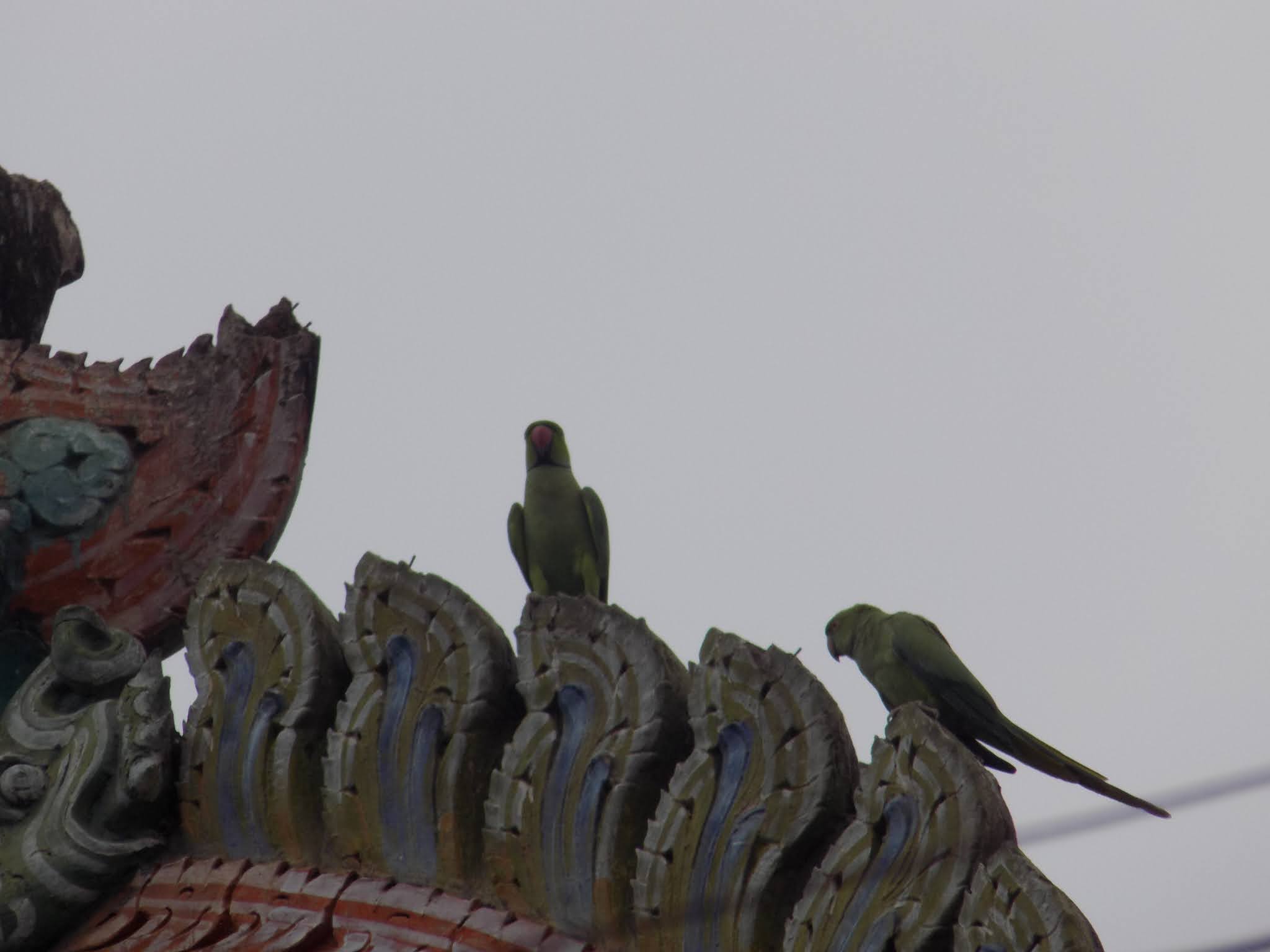
The Rose-ringed Parakeet/ Ring-necked Parakeet (Psittacula krameri) locally known as Pachchai Kili (பச்சை கிளி).

The Rose-ringed Parakeet (Psittacula krameri) near Medavakkam lake (Photo credit: U Elaya Perumal)

                     In the Medavakkam Marshland area we could observe more rose-ringed parakeets. they live on the palm trees near Medavkkam lake. Every day they fly through Annakkili Amma Research Institute and also often land on backyard trees of AARI. 

The Rose-ringed Parakeet (Psittacula krameri) near AARI (Photo credit: U Elaya Perumal)

                      The ring-necked parakeet, is a medium-sized parrot in the genus Psittacula, of the family Psittacidae. It has disjunct native ranges in Africa and the Indian Subcontinent and is now introduced into many other parts of the world where feral populations have established themselves and are bred for the exotic pet trade. Even in Chennai, it is illegally traded on many pet markets, for example at Chennai Pallavaram Friday market.
                   
The Rose-ringed Parakeet (Psittacula krameri) near Medavakkam lake (Photo credit: U Elaya Perumal)

                           Vibrantly bright green parakeet, frequently found in woodland, parks, gardens, where feeds mainly in trees. Nests in cavities, including holes in buildings. Easily overlooked if quiet, as the bright green plumage blends easily with foliage. Note the very long slender tail, bright red bill; male has narrow black-and-rose neck ring. Closely resembles the larger Alexandrine Parakeet, which has a wine-red patch on each shoulder. Like other parakeets, raucous and social, often appearing in noisy groups. Native to Africa and South Asia, introduced locally in Europe and Japan (Source: ebirds).

The Rose-ringed Parakeet (Psittacula krameri) in Tanjavur (Photo credit: U Elaya Perumal)

Scientific classification

Kingdom          : Animalia
Phylum             : Chordata
Class                 : Aves
Order                : Psittaciformes
Family              : Psittaculidae
Genus               : Psittacula
Binomial name :     Psittacula krameri Scopoli, 1769

The Rose-ringed Parakeet (Psittacula krameri) in Tanjavur (Photo credit: U Elaya Perumal)

                  இக்கிளிகளின் வால் நீண்டு கூர்மையாக முடிகிறது. பச்சை நிறத்துடன், வளைந்து சிவந்த அலகும், கருப்பு இளஞ்சிவப்பு கலந்த கழுத்து வளையம் போன்ற ஆரம் உடையது. இவ்வின பெண்கிளி எல்லாவகையிலும் ஆண்கிளி போல இருந்தாலும் இந்த ஆர வளையம் இல்லாமல் இருக்கும். இப்பறவைகள் கூண்டுகளில் வைத்து வளர்க்கப்படுகின்றன. இப்பறவைகள் மனிதர்கள் சொல்லும் சொற்களைக் கேட்டு அவற்றைத் திரும்பச் சொல்லக்கூடியவை. 

The Rose-ringed Parakeet (Psittacula krameri) in Tanjavur (Photo credit: U Elaya Perumal)


Paddyfield Pipit (Anthus rufulus) நெல்வயல் நெட்டைக்காலி Chennai wetland area | Birds of Perumbakkam Marshlands, Chennai city birds

Paddyfield pipit
Paddyfield pipit at Perumbakkam Marshland area (Photo Credit: U Elaya Perumal)

    Perumabakkam Marshland has much grassland areas, where we could observe more than 10 paddyfield Pipit. catching them with our camera was bit difficult. there were two major issues in photography one was the bird keep on moving they don't stand still anywhere.
another major issue was the background. most of the time they were standing on the dried plant materials hence the background and bird color were almost similar and there was no color contrast to focus with my simple SLR camera. but still, I could able to get somewhat well-focused pictures which I have given here... In early March one or two days a pair of pipit were observed near Annakkili Amma Research Institute (AARI), medavakkam marshland.

Paddyfield pipit at Perumbakkam Marshland area (Photo Credit: U Elaya Perumal)

    The paddy-field pipit or Oriental Pipit (Anthus rufulus) is a small passerine bird in the pipit and wagtail family. It is a resident (non-migratory) breeder in open scrub, grassland, and cultivation in southern Asia east to the Philippines. Although among the few breeding pipits in the Asian region, identification becomes difficult in winter when several other species migrate into the region. The taxonomy of the species is complex and has undergone considerable changes (Wikipedia).

Paddyfield pipit at Perumbakkam Marshland area (Photo Credit: U Elaya Perumal)

          A sparrow-sized, resident pipit with brown plumage that varies in tones in different parts of its range. All birds have a bi-colored bill with a curve to the tip of the upper bill. The breast is streaked and the upper parts have variable amounts of streaking. Juveniles show distinct and dark mottling on the upper parts. It is common in open habitats such as wetlands, farms, fields, and even large parks. Very similar to Blyth’s and Richard’s Pipits, but relatively compact and has a more distinct eyebrow, fainter or no streaking on the back of the neck, a larger head, and a shorter tail than either Blyth’s or Richard’s. Calls include short “tsip” and “tissip” notes (ebird).

Paddyfield pipit at Perumbakkam Marshland area (Photo Credit: U Elaya Perumal)

நெல்வயல் நெட்டைக்காலி (paddyfield pipit, அல்லது Oriental pipit, (Anthus rufulus) என்பது ஒரு சிறிய பாசரிபாரம்சு பறவை ஆகும். இது வாலாட்டிக் குருவிக் குடும்பத்தைச் சேர்ந்த பறவை ஆகும். இவை ஒரு பகுதியிலேயே வாழக்கூடியன (வலசை போகாதவை) இவை திறந்த வெளிகளிலும், புல்வெளிகளிலும் வாழக்கூடியன, தெற்கு ஆசியா, கிழக்குப் பிலிப்பீன்சு போன்ற பகுதிகளில் உள்ளன. பிற மற்ற இனங்கள் ஆசியாவின் பிற பகுதியில் காணப்படுகின்றன. ஆசிய பிராந்தியத்தில் குளிர்காலத்தில் இவ்வகைப் பறவைகளை அடையாளம் காண்பது கடினமாக இருக்கும். இனங்களின் வகைப்பாட்டில் சிக்கலான மற்றும் கணிசமான மாற்றங்கள் ஏற்பட்டிருக்கின்றன.

Black Drongo (Dicrurus macrocercus) இரட்டைவால் குருவி

வெண்புருவ வாலாட்டி White-browed Wagtail 

Pied Bushchat (Saxicola caprata) புதர்ச்சிட்டு

Purple-rumped Sunbird Leptocoma zeylonica ஊதாப்பிட்டத் தேன்சிட்டு

Eurasian Moorhen Gallinula chloropus தாழைக் கோழி

Bronze winged Jacana (Metopidius indicus) தாமிர இறக்கை இலைக்கோழி

White-breasted waterhen (Amaurornis phoenicurus) வெள்ளை நெஞ்சு நீர்க்கோழி

The greater flamingo (Phoenicopterus roseus) பெரும் பூநாரை

Indian spot-billed duck (Anas poecilorhyncha) புள்ளி மூக்கு வாத்து 

The glossy ibis (Plegadis falcinellus) அன்றில் Chennai wetland area | Birds of Medavakkam Marshlands, Chennai city birds

 Read More about Glossy ibis here

Glossy ibis feeding at Medavakkam Lake on 08/05/2021 (Photo Credit: U Elaya Perumal)

Glossy ibis was less frequently observed at Medavakkam Marshland during March and April as described in our earlier post. But in the month of May, they were observed in large groups at Medvakkam lake and near Annakkili Amma Research Institute. most of the days they more than 10 in number. every day we could observe them near AARI. someday they visit in the early morning some days at mid-noon and on other days at evening time. but they are not missing to visit the backyard of AARI. In Medavakkam lake, it more than observed at AARI.

Glossy ibis feeding at Medavakkam Lake on 07/05/2021 (Photo Credit: U Elaya Perumal)

Group of Glossy ibis feeding at Medavakkam Lake on 07/05/2021 (Photo Credit: U Elaya Perumal)


Glossy ibis feeding at Medavakkam Lake on 08/05/2021 (Photo Credit: U Elaya Perumal)

Glossy ibis feeding at Medavakkam Lake on 08/05/2021 (Photo Credit: U Elaya Perumal)

Glossy ibis feeding at Medavakkam Lake on 08/05/2021 (Photo Credit: U Elaya Perumal)

Glossy ibis feeding at Medavakkam Lake on 08/05/2021 (Photo Credit: U Elaya Perumal)

 Read More about Glossy ibis here

Black Drongo (Dicrurus macrocercus) இரட்டைவால் குருவி

வெண்புருவ வாலாட்டி White-browed Wagtail 

Pied Bushchat (Saxicola caprata) புதர்ச்சிட்டு

Purple-rumped Sunbird Leptocoma zeylonica ஊதாப்பிட்டத் தேன்சிட்டு

Eurasian Moorhen Gallinula chloropus தாழைக் கோழி

Bronze winged Jacana (Metopidius indicus) தாமிர இறக்கை இலைக்கோழி

White-breasted waterhen (Amaurornis phoenicurus) வெள்ளை நெஞ்சு நீர்க்கோழி

The greater flamingo (Phoenicopterus roseus) பெரும் பூநாரை

Indian spot-billed duck (Anas poecilorhyncha) புள்ளி மூக்கு வாத்து 

The greater flamingo (Phoenicopterus roseus) பெரும் பூநாரை Chennai Wetland Birds Perumbakkam Marshland birds || Bird watching

The greater flamingo (Phoenicopterus roseus) பெரும் பூநாரை

    Common at Perumbakkam Mashland area but have not observed at Medavakkam lake area. 

The greater flamingo (Phoenicopterus roseus) Photo credit: U Elaya Perumal

         Distributed from Africa and southern Europe through West Asia to South Asia. Very large, with long, "coat hanger" neck, big kinked bill, and very long pinkish legs. Plumage at rest whitish with pale pink blush and some deep pink often visible on closed wings. Flies with long neck and legs extended, when deep pink-and-black wing pattern striking (ebird).


The greater flamingo (Phoenicopterus roseus) Photo credit: U Elaya Perumal


The greater flamingo (Phoenicopterus roseus) is the most widespread and largest species of the flamingo family. It is found in Africa, the Indian subcontinent, the Middle East, and in southern Europe (wikipedia).
The greater flamingo (Phoenicopterus roseus) Photo credit: U Elaya Perumal
பெரும் பூநாரை (Greater Flamingo) என்பது நாரைக் குடும்பத்தைச் சேர்ந்த ஒரு பறவையாகும். இதன் அறிவியல் பெயர் பீனிகாப்டெரசு ரோசசு என்பதாகும். நம் வீடுகளில் வளரும் வாத்தின் பருமனுடைய இப்பறவைக்கு நீண்ட முடியற்ற சிவந்த கால்களும், நீண்டு வளைந்த கழுத்தும், குறுகிய வளைந்த அலகும் இருக்கும். கால் விரல்கள் வாத்துக்கு இருப்பது போலவே சவ்வினால் இணைந்திருக்கும். நிமிர்ந்து நின்றால் 1 1/2 மீட்டர் உயரம் இருக்கும். இப்பறவைகள் செந்நிறம் கலந்த வெள்ளையுடலும் கரு நிறமான இறக்கை ஓரமும் கொண்டவை. நிலத்திலும் அதிக உப்புத்தன்மை அதிகமுள்ள ஏரிகளில் கடும் வெப்பத்தையும் தாங்கி வாழும் பூநாரை, தமிழகத்திலுள்ள கோடியக்கரை வனவுயிரினங்கள், பறவைகள் உய்விடம் புகலிடத்திற்கு வரும் எண்ணற்ற பறவைகளில் மிகவும் அழகான ஒன்று. இப்பறவைகள் கூட்டம் கூட்டமாகப் பறந்து உயரச் செல்லும் காட்சி மனதைக் கவரும் தன்மை உடையது (wikipedia).

The greater flamingo (Phoenicopterus roseus) Photo credit: U Elaya Perumal

Indian spot-billed duck (Anas poecilorhyncha) புள்ளி மூக்கு வாத்து அல்லது புள்ளி மூக்கன் Chennai Wetland Birds Perumbakkam Marshland birds || Bird watching

 Indian spot-billed duck 

Indian spot-billed duck (Anas poecilorhyncha) at Perumbakam Marshland (Photo Credit: U Elaya Perumal)
அலகின் (அலகின்) நுனியில் ஒரு மஞ்சள் நிறப்புள்ளி உள்ளது இவைகளின் தனிச்சிறப்பு.

Scientific classification

Kingdom: Animalia

Phylum: Chordata

Class: Aves

Order: Anseriformes

Family: Anatidae

Genus: Anas

Species: A. poecilorhyncha

Binomial name: Anas poecilorhyncha Forster, 1781


Indian spot-billed duck (Anas poecilorhyncha) at Perumbakam Marshland (Photo Credit: U Elaya Perumal)

The spot-billed duck species was little frequent at Perumbakkam Marshland and they were flying towards Pallikaranai Marshland direction. In Medavakkam lake only once during mid of March we have sited some of these ducks but not on other days. that does not mean these birds are not present in Medvakkam wetland area, we might be missing the time for observing these birds.

Indian spot-billed duck (Anas poecilorhyncha) at Perumbakam Marshland (Photo Credit: U Elaya Perumal)


Indian spot-billed duck (Anas poecilorhyncha) at Perumbakam Marshland (Photo Credit: U Elaya Perumal)

The Indian spot-billed duck (Anas poecilorhyncha) is a large dabbling duck that is a non-migratory breeding duck throughout freshwater wetlands in the Indian subcontinent. The name is derived from the red spot at the base of the bill that is found in the mainland Indian population. When in water it can be recognized from a long distance by the white tertials that form a stripe on the side, and in-flight it is distinguished by the green speculum with a broad white band at the base. This species and the eastern spot-billed duck (A. zonorhyncha) were formerly considered conspecific, together called the spot-billed duck (A. poecilorhyncha) Source: Wikipedia.

Indian spot-billed duck (Anas poecilorhyncha) at Perumbakam Marshland (Photo Credit: U Elaya Perumal)

A large grayish-brown duck with a diagnostic yellow-tipped black bill and a red spot at the base of the bill (missing in certain subspecies). In-flight, note the green panel in the wing that is bordered in white. Often seen in small groups dabbling or tipping up in shallow water or walking on marshy land at the edge of freshwater lakes or in cultivated fields. Usually not seen associating with other species. Similar to Eastern Spot-billed Duck, but note green wing panel, lack of a distinct dark "moustache", and overall warmer tan coloration (Source Ebirds).


Common Greenshank (Tringa nebularia): Taxonomy, Identification, Ecology and Occurrence at Mahanadi River at Cuttack, Odisha,

  Common Greenshank ( Tringa nebularia ): Taxonomy, Identification, Ecology and Occurrence at Chilika Lake, Odisha Abstract The Common Green...