Showing posts with label birds. Show all posts

The Silent Sentinel of a River: A Field Encounter with the Striated Heron (Butorides striata) in Central India

 The Silent Sentinel of a River: A Field Encounter with the Striated Heron (Butorides striata) in Central India

Abstract

Not every remarkable wildlife encounter occurs inside a national park or a well-known bird sanctuary. Sometimes, a small freshwater rivulet hidden among rocks and riparian vegetation reveals an equally fascinating story of survival. During a field visit on 20 April 2025, a solitary Striated Heron (Butorides striata) was observed hunting along a rivulet immediately upstream of its confluence with the Satna River in Madhya Pradesh, India (24.507557° N, 80.875699° E). The observation offered an opportunity to study one of India's most accomplished freshwater predators in its natural environment.


Unlike conspicuous egrets that often dominate open wetlands, the Striated Heron relies on camouflage, patience, and precision rather than speed. This article explores the natural history of the species through a field observation, highlighting how even small river systems contribute to freshwater biodiversity and why protecting such habitats is essential for sustaining resident bird populations.


Where Two Waters Meet

Every river has a story, and many begin long before the main channel becomes visible on a map. Small rivulets, seasonal streams, and rocky channels quietly gather rainwater and groundwater, carrying life toward larger rivers. These seemingly modest watercourses are often overlooked, yet they support a surprising diversity of aquatic organisms and wildlife.

On 20 April 2025, while walking along one such rivulet just before it merged with the Satna River in central India, the landscape appeared almost motionless. Clear water flowed gently between weathered rocks, dragonflies skimmed the surface, and the calls of distant birds echoed through the riparian vegetation. At first glance, nothing suggested the presence of a predator.

Then a slight movement along the opposite bank caught the eye.

Standing perfectly still among stones and shallow water was a bird so well camouflaged that it almost disappeared into the landscape. Only its bright yellow eye betrayed its presence. The bird remained motionless for several minutes before taking a slow, deliberate step toward the water's edge. A few seconds later, it struck with astonishing speed.

The hunter was a Striated Heron (Butorides striata).


An Artist of Disappearance

Unlike larger members of the heron family that often feed in open marshes or paddy fields, the Striated Heron specializes in discretion. Every aspect of its appearance appears designed to avoid detection.


The slate-grey crown resembles wet river stones. Olive-brown wings blend with weathered rock and dried vegetation. Fine streaks across the throat mimic the play of light and shadow along the riverbank. Even when standing only a few metres away, the bird can remain almost invisible.

This extraordinary camouflage is not merely defensive—it is an essential hunting adaptation.

Many freshwater fishes, tadpoles, and aquatic insects are highly sensitive to movement. Any sudden motion may send potential prey darting into deeper water. Remaining undetected gives the heron a decisive advantage, allowing it to approach prey without triggering an escape response.

The photographs accompanying this observation beautifully illustrate this adaptation. Against the rocky substrate of the rivulet, the bird's plumage merges almost seamlessly with its surroundings, demonstrating why casual observers often overlook this species despite its widespread distribution across India.


A Hunter That Measures Time Differently

Watching the Striated Heron challenges our usual perception of hunting. Modern predators are often associated with speed—a falcon diving through the sky or a kingfisher plunging into water. The Striated Heron follows a different philosophy.

It hunts through patience.

For several minutes, the bird scarcely moved. Its body remained low, neck partially folded, eyes fixed upon the shallow current. Rather than walking continuously, it advanced one cautious step at a time, pausing repeatedly as though studying every ripple in the water.

When prey finally entered striking distance, the attack was almost impossible to follow with the naked eye. The neck unfolded in a fraction of a second, transforming the apparently motionless bird into an extraordinarily efficient predator.

This combination of stillness and explosive speed has enabled the Striated Heron to thrive in freshwater ecosystems across much of the world.


Identifying the Observer's Bird

The individual observed displayed the diagnostic characteristics of an adult Striated Heron (Butorides striata), including:

  • Slate-grey crown and mantle.
  • Rich chestnut-brown sides of the neck.
  • White throat marked with fine dark streaks.
  • Bright yellow iris.
  • Greenish-yellow lores.
  • Long, sharply pointed black bill.
  • Yellowish-green legs.
  • Pale spotting on the wing coverts.
  • Compact body with a characteristic crouched hunting posture.

These features distinguish it from superficially similar species such as the Indian Pond Heron (Ardeola grayii), which has heavier streaking on the neck and a different body profile.


More Than a Bird

This encounter was also a reminder that biodiversity is not confined to protected reserves or internationally recognized wetlands. Small tributaries, seasonal rivulets, and river confluences serve as vital habitats for countless species, many of which remain largely unnoticed.

Healthy freshwater ecosystems are built upon these smaller waterways. They support aquatic insects, fishes, amphibians, reptiles, mammals, and birds, forming ecological networks that ultimately sustain larger river systems.

The solitary Striated Heron standing silently beside this rivulet represented not only a remarkable bird but also the ecological integrity of the stream itself.

The Master of Stillness

The first impression of a Striated Heron is often deceptive. Standing motionless along the water's edge, it appears almost detached from its surroundings, as though it were simply another weathered stone on the riverbank. Yet beneath this calm exterior lies one of the most efficient freshwater predators found in Asian rivers and wetlands.

Unlike many birds that rely on speed or endurance, the Striated Heron has evolved an entirely different hunting strategy—one based on patience, precision, and an exceptional understanding of its environment.


The Art of Ambush

Every movement made by the Striated Heron appears deliberate. During the observation at the rivulet flowing into the Satna River, the bird remained almost perfectly still for several minutes. Only subtle head movements indicated that it was continuously monitoring the shallow water before it.

Rather than actively chasing prey, the heron allows prey to come within striking distance. When a small fish, tadpole, or aquatic insect moves close enough, the folded neck suddenly extends with remarkable speed, driving the sharp bill into the water with extraordinary accuracy.

This ambush strategy offers several advantages. It conserves energy, minimizes disturbance to the water surface, and increases the likelihood of catching alert prey that would quickly escape from a more active hunter. In clear, shallow streams where prey can detect movement easily, patience often proves more effective than speed.


Built for Life Along the Water

The Striated Heron possesses several anatomical adaptations that make it exceptionally suited to hunting in freshwater habitats.

Its long, dagger-shaped bill functions as both a spear and forceps, allowing the bird to seize slippery prey with precision. The neck contains highly flexible vertebrae and powerful muscles that enable the rapid extension necessary for striking.

Equally important are its eyes. Positioned to provide excellent binocular vision, they allow the heron to judge distances accurately despite the refraction of light through water. This depth perception is essential when targeting fast-moving prey beneath the surface.

Its relatively short legs, compared with larger herons, are ideal for navigating rocky river margins, submerged stones, and shallow pools. The compact body and low centre of gravity also improve balance on uneven substrates, enabling the bird to hunt effectively where larger wading birds may struggle.


A Diverse Freshwater Diet

The Striated Heron is an opportunistic carnivore whose diet reflects the diversity of organisms found in healthy freshwater ecosystems.

Its principal prey includes:

  • small fishes,
  • tadpoles,
  • frogs,
  • freshwater shrimps,
  • crabs,
  • aquatic beetles,
  • dragonfly larvae,
  • water bugs,
  • molluscs,
  • small reptiles, including young lizards.

The exact composition of the diet varies with habitat and season. In shallow streams such as the one observed in central India, fishes and aquatic insects form the bulk of its prey, while crabs and shrimps become increasingly important in estuarine and mangrove environments.

Because the species occupies a relatively high position in the aquatic food web, it also serves as an indicator of healthy freshwater ecosystems. Rivers capable of sustaining Striated Herons generally support diverse fish populations and productive invertebrate communities.


One of Nature's Patient Hunters

Among freshwater birds, few display the remarkable patience of the Striated Heron. Individuals have been observed remaining motionless for extended periods before making a single decisive strike.

This behaviour requires exceptional energy efficiency. Instead of expending energy through constant movement, the bird invests time in careful observation. Every ripple, shadow, and flash beneath the water's surface is assessed before action is taken.

The field photographs captured during this observation illustrate this perfectly. In both images, the bird adopts its characteristic low, forward-leaning posture with the neck partially folded, ready to strike without warning. Such behaviour exemplifies why the species is regarded as one of the finest ambush predators among freshwater birds.


A Bird That Uses Tools

Perhaps one of the most remarkable aspects of the Striated Heron's natural history is its documented ability to use tools—an uncommon behaviour among birds.

Researchers have observed individuals placing feathers, leaves, insects, or small twigs on the water surface to attract curious fish. When a fish approaches the floating object, the heron rapidly captures it.

This behaviour has been documented in several parts of the world and demonstrates a level of behavioural flexibility rarely associated with wading birds. Although not every individual uses tools, the observations suggest that the species possesses considerable learning ability and can adapt its hunting techniques to local conditions (Lefebvre et al., 2002).


Life Along Small Rivers

Large wetlands often receive considerable conservation attention, but smaller streams and rivulets are equally important for species such as the Striated Heron.

The unnamed rivulet observed during this field visit, flowing into the Satna River, illustrates this point well. Its shallow pools, gently flowing water, rocky margins, and patches of riparian vegetation create a mosaic of microhabitats supporting fish, amphibians, aquatic insects, and crustaceans. These organisms, in turn, sustain predators like the Striated Heron.

Such small watercourses also function as ecological corridors, linking larger rivers and wetlands while facilitating the movement of aquatic organisms. Protecting these tributaries is therefore essential for maintaining the overall health of river ecosystems.


An Indicator of Healthy Freshwater Ecosystems

Although the Striated Heron is classified globally as a species of Least Concern, its continued presence depends upon clean, functioning freshwater habitats.

Healthy rivers provide:

  • abundant prey,
  • stable water levels,
  • natural riverbank vegetation,
  • undisturbed nesting sites,
  • minimal chemical pollution.

Conversely, declining water quality, excessive sand mining, channel modification, and the removal of riparian vegetation reduce habitat suitability for the species. Because of its close association with freshwater ecosystems, the Striated Heron is often regarded as a useful indicator of river health.

Observing this bird along a relatively undisturbed tributary of the Satna River serves as a reminder that even modest streams can harbour rich biodiversity when their ecological integrity is maintained.

Rivers Worth Protecting

The quiet observation of a Striated Heron along a small rivulet before it joins the Satna River is more than an interesting bird sighting. It is a reminder that healthy freshwater ecosystems are built from countless small streams and tributaries that collectively sustain biodiversity across an entire river basin. Although these habitats rarely receive the attention given to major rivers or protected wetlands, they are indispensable for wildlife and human communities alike.


A Resident of Rivers Across the World

The Striated Heron (Butorides striata) is among the most widely distributed members of the heron family. Its range extends across Africa, Madagascar, southern Europe, the Middle East, South Asia, Southeast Asia, Australia, and numerous Pacific islands (BirdLife International, 2024).

In India, it is a resident species, occurring throughout the year in a wide variety of freshwater and coastal habitats. It is frequently encountered along:

  • rivers and tributaries,
  • lakes and reservoirs,
  • irrigation canals,
  • village ponds,
  • marshes,
  • mangroves,
  • estuaries,
  • paddy fields.

Unlike many migratory waterbirds, the Striated Heron does not undertake long seasonal migrations. Instead, individuals usually remain within local river systems, moving only short distances in response to changing water levels or food availability.

Because of this close association with freshwater habitats, local populations often reflect the ecological condition of the rivers they inhabit.


Breeding Along Quiet Waterways

Breeding generally coincides with the onset of the monsoon or periods of increased food availability, although timing varies across different parts of India.

The Striated Heron usually nests in secluded places where disturbance is minimal. Nests are commonly built in:

  • riverside trees,
  • shrubs overhanging water,
  • dense riparian vegetation,
  • mangroves,
  • bamboo clumps.

The nest itself is a simple platform of twigs lined with smaller plant material.

Typical breeding characteristics include:

  • clutch size of 3–5 pale blue-green eggs,
  • incubation lasting about 20–23 days,
  • both parents sharing incubation and chick rearing,
  • nestlings remaining in the nest for approximately three weeks before fledging.

The dependence on riverside vegetation highlights the importance of conserving natural riparian habitats. Removal of trees and shrubs along riverbanks not only accelerates erosion but also eliminates suitable nesting sites for many bird species.


Challenges Facing Freshwater Birds

Although the Striated Heron is currently listed as Least Concern by the International Union for Conservation of Nature (IUCN), its habitat is increasingly affected by human activities (BirdLife International, 2024).

Major threats include:

  • pollution from untreated sewage,
  • agricultural runoff,
  • indiscriminate sand mining,
  • river channel modification,
  • removal of riparian vegetation,
  • construction activities,
  • excessive extraction of river water,
  • plastic pollution,
  • disturbance from human recreation.

Smaller tributaries are particularly vulnerable because they are often excluded from formal conservation programmes despite supporting diverse aquatic communities.

The cumulative impact of habitat degradation may not immediately eliminate resident birds, but it gradually reduces prey availability, nesting opportunities, and overall ecosystem resilience.


Why Small Tributaries Matter

Large rivers depend upon healthy tributaries. Every stream contributes water, nutrients, sediments, and biodiversity to the main river channel.

The rivulet where this Striated Heron was photographed illustrates this principle perfectly. Despite its modest size, it supports aquatic insects, fishes, amphibians, reptiles, and birds, functioning as a self-contained ecosystem before merging with the Satna River.

Such habitats provide:

  • breeding areas for fishes,
  • refuges for amphibians,
  • feeding grounds for waterbirds,
  • corridors connecting larger aquatic ecosystems,
  • natural filtration of sediments and nutrients.

Protecting these smaller waterways therefore benefits the entire river basin.

The presence of a top freshwater predator such as the Striated Heron suggests that the ecosystem still retains much of its natural ecological complexity.


A Bird That Represents Healthy Rivers

Birds often serve as ambassadors for ecosystem conservation, and the Striated Heron is no exception.

Unlike spectacular migratory flocks that attract immediate attention, this species quietly performs its ecological role every day by regulating populations of fishes, insects, amphibians, and crustaceans. Its survival depends on clean water, abundant prey, and undisturbed riverbanks.

For naturalists, photographers, and conservationists, encountering a Striated Heron is often a sign that a river still possesses many of the characteristics of a functioning freshwater ecosystem.

Each observation therefore contributes valuable information to our understanding of local biodiversity and highlights the importance of continued monitoring of India's inland waterways.


Conclusion

The observation of a Striated Heron (Butorides striata) on 20 April 2025 along a small freshwater rivulet immediately upstream of its confluence with the Satna River in Madhya Pradesh demonstrates how even modest watercourses support remarkable wildlife.

Patient, inconspicuous, and exceptionally well adapted to its environment, the Striated Heron exemplifies the intricate relationships that exist within freshwater ecosystems. Its camouflage, hunting strategy, and dependence on healthy aquatic habitats make it one of the most fascinating resident birds of India's rivers.

The encounter also underscores an important conservation message: safeguarding biodiversity is not limited to protecting large wetlands or famous rivers. Countless unnamed streams, rivulets, and tributaries form the ecological foundation of larger river systems. Their preservation ensures the survival of species like the Striated Heron and countless other organisms that depend upon clean, flowing freshwater.

As pressures from pollution, habitat alteration, and unsustainable resource use continue to grow, protecting these overlooked waterways will become increasingly important. Every healthy tributary strengthens the resilience of the larger river it joins, reminding us that conservation often begins in the smallest places.


References (APA 7th Edition)

Ali, S. (2002). The Book of Indian Birds (13th ed.). Bombay Natural History Society.

BirdLife International. (2024). Butorides striata (Striated Heron). BirdLife Data Zone.

del Hoyo, J., Elliott, A., Sargatal, J., Christie, D. A., & de Juana, E. (Eds.). (2020). Handbook of the Birds of the World Alive. Lynx Edicions.

Gill, F., Donsker, D., & Rasmussen, P. (Eds.). (2024). IOC World Bird List (Version 14.1). International Ornithologists' Union.

Grimmett, R., Inskipp, C., & Inskipp, T. (2011). Birds of the Indian Subcontinent (2nd ed.). Oxford University Press.

Kushlan, J. A., & Hancock, J. A. (2005). The Herons. Oxford University Press.

Rasmussen, P. C., & Anderton, J. C. (2005). Birds of South Asia: The Ripley Guide. Smithsonian Institution & Lynx Edicions.

Wetlands International. (2023). Waterbird Conservation in Asia and the Central Asian Flyway.

by Dr. U Elaya Perumal.

The scaly-breasted munia or spotted munia புள்ளிச் சில்லை (Lonchura punctulata), Chennai wetland area | Birds of Medavakkam Marshlands, Chennai city birds

புள்ளிச் சில்லை - Lonchura punctulata 

    The Scaly-breasted Munia is a small-sized bird. Attractive small songbird of grasslands, gardens, fields, and agricultural areas. Native to India and Southeast Asia, with introduced populations scattered elsewhere around the world. Typical adults dark chestnut-brown above, white below, with the fine dark scaly pattern on belly; some populations duller brown. Juveniles plain brown all over with slightly paler underparts. Typically found in small flocks, sometimes mixed with other species of munia.

The scaly-breasted munia or spotted munia (Lonchura punctulata) at Medavakkam near Annakkili Amma Research Institute (Photo Credit: U Elaya Perumal)

    In Chennai wetlands, we have observed Scaly-breasted at different times, in February 2021 the juvenile Scaly-breasted munia was seen near AARI. then we have not noticed any Scaly-breasted munia near AARI. but in June 2021 the flock of Scaly-breasted munia was crossing AARI in the evening time from west to east, in the morning also they may cross but we have not seen them. in morning time these four Scaly-breasted Munia used to visit the bush in front of AARI. 

The scaly-breasted munia or spotted munia (Lonchura punctulata) at Medavakkam near Annakkili Amma Research Institute (Photo Credit: U Elaya Perumal)

புள்ளிச் சில்லை என்பது சில்லை எனப்படும் திணைக்குருவி வகையைச் சேர்ந்த சிட்டுக்குருவி அளவிலான ஒரு பறவை. இது ஆசியாவைத் தாயகமாகக் கொண்டது. இது 1758-இல் லின்னேயசால் அறிவியல் முறைப்படி பெயரிடப்பட்டது.

The scaly-breasted munia or spotted munia (Lonchura punctulata) at Medavakkam near Annakkili Amma Research Institute (Photo Credit: U Elaya Perumal)

Scientific classification 

Kingdom:    Animalia
Phylum:           Chordata
Class:            Aves
Order:            Passeriformes
Family:            Estrildidae
Genus:            Lonchura
Species:            L. punctulata
Binomial name: Lonchura punctulata (Linnaeus, 1758)

The scaly-breasted munia or spotted munia (Lonchura punctulata) at Medavakkam near Annakkili Amma Research Institute (Photo Credit: U Elaya Perumal)
    
        This munia eats mainly grass seeds apart from berries and small insects. They forage in flocks and communicate with soft calls and whistles. The species is highly social and may sometimes roost with other species of munias. This species is found in tropical plains and grasslands. Breeding pairs construct dome-shaped nests using grass or bamboo leaves.

The species is endemic to Asia and occurs from India and Sri Lanka east to Indonesia and the Philippines (where it is called mayang pakíng).

Cinnamon Bittern செங்குருகு (Ixobrychus cinnamomeus) Chennai wetland area | Birds of Medavakkam Marshlands, Chennai city birds


Cinnamon Bittern செங்குருகு (Ixobrychus cinnamomeus) at backyard of Annakkili Amma Research Institute (Photo Credit: U Elaya Perumal)

Cinnamon Bittern செங்குருகு (Ixobrychus cinnamomeus)

This bird was observed since March 2021, but it was very rarely seen, that too while flying away. They stay inside the bushes, if we go near to bushes they fly away... the earlier observations were from Medavakkam Lake. During those time they simply fly away and escape, I was not able to notice its characters properly hence I could not identify. This bird is very new to me so I need to check all its characters to identify it because I have never seen it before. this was happening till May 2021.

In may 2021 that miracle happened this bittern straight away reached the bush in front of our home. that is the time I could see it properly. when I saw the bill (peak) of this bird I recognized as it is a bittern, later found it was Cinnamon bittern. a couple of bitter was visiting our place to stay protected, which is the same place where Moorhen was hatched their chicks. But now White-Breasted Waterhen has occupied the place, hence after trying for two three days this bittern left that area.

Even though it was visiting nearby we could not take clear pictures because it was full of bushes, but on one day evening, we could observe a bittern in an open space. I was called by the AARI admin to take pictures and immediately I went and clicked a lot of pictures. it was giving a nice pose. for the first and last time, it didn't fly away after seeing me. it was literally seeing me by turning its neck but didn't fly. our recent observation confirms that they stay at the backside of the AARI building, where birds like Bronze-winged Jacana, The Eurasian Moorhen, White-breasted Waterhen, Grey-headed Swamphen have bred. I hope this bittern couple also will breed over there, it is in the center of wetland, filled with two Palm trees, Typha, and some thorny trees, The bush is thicker and safer except for the issues with snakes. 
Here are some pictures Cinnamon Bittern (செங்குருகு) for you to see...

Cinnamon Bittern செங்குருகு (Ixobrychus cinnamomeus) at the backyard of Annakkili Amma Research Institute (Photo Credit: Elaya Perumal)

Cinnamon Bittern செங்குருகு (Ixobrychus cinnamomeus) looking at me weirdly from the backyard of Annakkili Amma Research Institute (Photo Credit: Elaya Perumal)


யாரும் இல்லை; தானே கள்வன்;
தான் அது பொய்ப்பின், யான் எவன் செய்கோ?
தினை தாள் அன்ன சிறு பசுங் கால
ஒழுகு நீர் ஆரல் பார்க்கும்
குருகும் உண்டு, தான் மணந்த ஞான்றே.
கபிலர் (குறுந்தொகை 25)
In the above-mentioned Poem, the great poet Kabilar mentioned the characters of Bittern... 

Thank you all...

Stay Home Stay Safe

Help Nature to Recover...

The Purple Heron (Ardea purpurea) செந்நாரை | Chennai wetland area | Birds of Perumbakkam & Medavakkam Marshlands, Chennai city birds

 Purple Heron செந்நாரை

                Purple heron is one of the most confusing heron, and most similar to the grey heron. There are some noticeable differences which helps in the identification. this birds have been observed at Perumbakkam and Medavakkam wetland areas (we have not visited Pallikaranai marshland). 


 Purple Heron at Perumbakkam Marshland area (Photo Credit U Elaya Perumal)

                It is similar in appearance to the more common grey heron but is slightly smaller, more slender, and has darker plumage. It is also a more evasive bird, favoring densely vegetated habitats near water, particularly reed beds. It hunts for a range of prey including fish, rodents, frogs, and insects, either stalking them or standing waiting in ambush (source ebird).

 Purple Heron at Perumbakkam Marshland area with its prey (Photo Credit U Elaya Perumal)

                       This is shorter than the crest of the grey heron and does not exceed 140 mm (5.5 in). The sides of the head and the neck are buffish chestnut, with dark streaks and lines down either side of the whole the neck. The mantle is oily brown and the upper scapular feathers are elongated but not the lower ones. The rest of the upper parts and the tail are brownish grey. The front of the neck is paler than the sides and there are some elongated feathers at the base of the neck which are streaked with white, chestnut and black. The breast is chestnut brown, with some blackening at the side, and the belly and under-tail coverts are black. The brownish-yellow beak is long, straight and powerful, and is brighter in colour in breeding adults. The iris is yellow and the legs are brown at the front and yellowish behind (Source: Wikipedia).

 Purple Heron at Perumbakkam Marshland area with its prey (Photo Credit U Elaya Perumal)

              இது சாம்பல் நாரையை விடவும் சிறியதாகவும் இலேசாகவும் உள்ளது. இதனை சாம்பல் நாரையிடமிருந்து வேறுபடுத்திக்கட்டுவது யாதெனின் இதன் இள்ஞ்சிவப்பு நிற உடலே. வளர்ந்த பறவைகள் கருத்த பழுப்பு நிறத்தையும் கொண்டிருக்கின்றன. இவை குறுகிய வடிவிலான மஞ்சள் அலகினை உடையது. செந்நாரைக்கு உருவத்தில் மிகவும் அருகாமையில் உள்ள நாரை இவற்றை விட உருவில் பெரிய கோலியாத்து நாரை.

இவை ஆப்பிரிக்காவிலும், மத்திய மற்றும் தெற்கு ஐரோப்பாவிலும், தென் மற்றும் கிழக்கு ஆசியாவிலும் வாழ்கின்றன. எனினும் ஐரோப்பிய இனங்கள் குளிர் காலங்களில் ஆப்பிரிக்காவை நோக்கி வலசை வருகின்றன. ஆசிய இனங்களோ வடக்கும் தெற்கும் ஆசியாவிற்குள்ளேயே வலசை வருகின்றன.


The Rose-ringed Parakeet (Psittacula krameri) பச்சைக்கிளி | Chennai wetland area | Birds of Medavakkam Marshlands, Chennai city birds

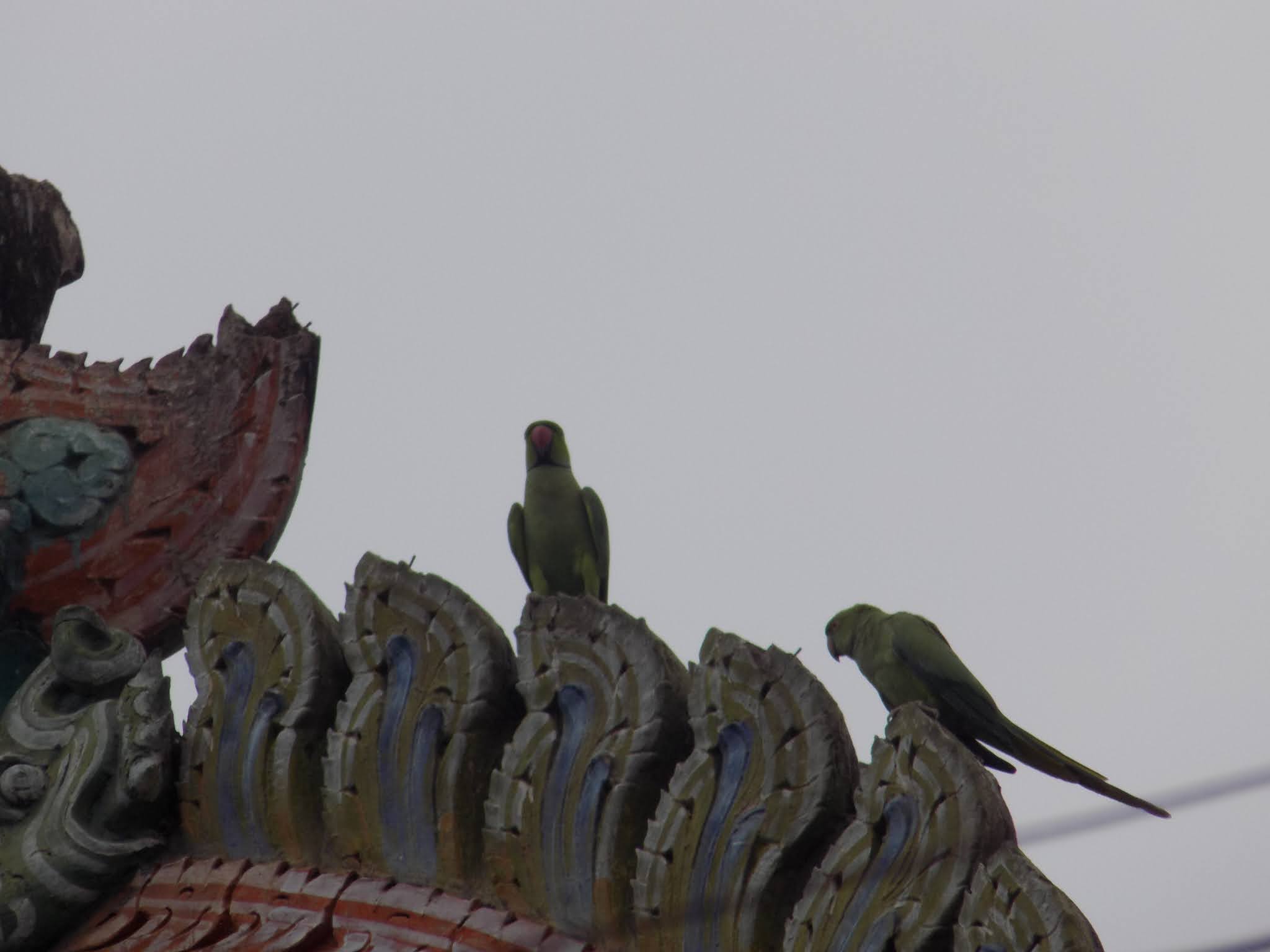
The Rose-ringed Parakeet/ Ring-necked Parakeet (Psittacula krameri) locally known as Pachchai Kili (பச்சை கிளி).

The Rose-ringed Parakeet (Psittacula krameri) near Medavakkam lake (Photo credit: U Elaya Perumal)

                     In the Medavakkam Marshland area we could observe more rose-ringed parakeets. they live on the palm trees near Medavkkam lake. Every day they fly through Annakkili Amma Research Institute and also often land on backyard trees of AARI. 

The Rose-ringed Parakeet (Psittacula krameri) near AARI (Photo credit: U Elaya Perumal)

                      The ring-necked parakeet, is a medium-sized parrot in the genus Psittacula, of the family Psittacidae. It has disjunct native ranges in Africa and the Indian Subcontinent and is now introduced into many other parts of the world where feral populations have established themselves and are bred for the exotic pet trade. Even in Chennai, it is illegally traded on many pet markets, for example at Chennai Pallavaram Friday market.
                   
The Rose-ringed Parakeet (Psittacula krameri) near Medavakkam lake (Photo credit: U Elaya Perumal)

                           Vibrantly bright green parakeet, frequently found in woodland, parks, gardens, where feeds mainly in trees. Nests in cavities, including holes in buildings. Easily overlooked if quiet, as the bright green plumage blends easily with foliage. Note the very long slender tail, bright red bill; male has narrow black-and-rose neck ring. Closely resembles the larger Alexandrine Parakeet, which has a wine-red patch on each shoulder. Like other parakeets, raucous and social, often appearing in noisy groups. Native to Africa and South Asia, introduced locally in Europe and Japan (Source: ebirds).

The Rose-ringed Parakeet (Psittacula krameri) in Tanjavur (Photo credit: U Elaya Perumal)

Scientific classification

Kingdom          : Animalia
Phylum             : Chordata
Class                 : Aves
Order                : Psittaciformes
Family              : Psittaculidae
Genus               : Psittacula
Binomial name :     Psittacula krameri Scopoli, 1769

The Rose-ringed Parakeet (Psittacula krameri) in Tanjavur (Photo credit: U Elaya Perumal)

                  இக்கிளிகளின் வால் நீண்டு கூர்மையாக முடிகிறது. பச்சை நிறத்துடன், வளைந்து சிவந்த அலகும், கருப்பு இளஞ்சிவப்பு கலந்த கழுத்து வளையம் போன்ற ஆரம் உடையது. இவ்வின பெண்கிளி எல்லாவகையிலும் ஆண்கிளி போல இருந்தாலும் இந்த ஆர வளையம் இல்லாமல் இருக்கும். இப்பறவைகள் கூண்டுகளில் வைத்து வளர்க்கப்படுகின்றன. இப்பறவைகள் மனிதர்கள் சொல்லும் சொற்களைக் கேட்டு அவற்றைத் திரும்பச் சொல்லக்கூடியவை. 

The Rose-ringed Parakeet (Psittacula krameri) in Tanjavur (Photo credit: U Elaya Perumal)


Paddyfield Pipit (Anthus rufulus) நெல்வயல் நெட்டைக்காலி Chennai wetland area | Birds of Perumbakkam Marshlands, Chennai city birds

Paddyfield pipit
Paddyfield pipit at Perumbakkam Marshland area (Photo Credit: U Elaya Perumal)

    Perumabakkam Marshland has much grassland areas, where we could observe more than 10 paddyfield Pipit. catching them with our camera was bit difficult. there were two major issues in photography one was the bird keep on moving they don't stand still anywhere.
another major issue was the background. most of the time they were standing on the dried plant materials hence the background and bird color were almost similar and there was no color contrast to focus with my simple SLR camera. but still, I could able to get somewhat well-focused pictures which I have given here... In early March one or two days a pair of pipit were observed near Annakkili Amma Research Institute (AARI), medavakkam marshland.

Paddyfield pipit at Perumbakkam Marshland area (Photo Credit: U Elaya Perumal)

    The paddy-field pipit or Oriental Pipit (Anthus rufulus) is a small passerine bird in the pipit and wagtail family. It is a resident (non-migratory) breeder in open scrub, grassland, and cultivation in southern Asia east to the Philippines. Although among the few breeding pipits in the Asian region, identification becomes difficult in winter when several other species migrate into the region. The taxonomy of the species is complex and has undergone considerable changes (Wikipedia).

Paddyfield pipit at Perumbakkam Marshland area (Photo Credit: U Elaya Perumal)

          A sparrow-sized, resident pipit with brown plumage that varies in tones in different parts of its range. All birds have a bi-colored bill with a curve to the tip of the upper bill. The breast is streaked and the upper parts have variable amounts of streaking. Juveniles show distinct and dark mottling on the upper parts. It is common in open habitats such as wetlands, farms, fields, and even large parks. Very similar to Blyth’s and Richard’s Pipits, but relatively compact and has a more distinct eyebrow, fainter or no streaking on the back of the neck, a larger head, and a shorter tail than either Blyth’s or Richard’s. Calls include short “tsip” and “tissip” notes (ebird).

Paddyfield pipit at Perumbakkam Marshland area (Photo Credit: U Elaya Perumal)

நெல்வயல் நெட்டைக்காலி (paddyfield pipit, அல்லது Oriental pipit, (Anthus rufulus) என்பது ஒரு சிறிய பாசரிபாரம்சு பறவை ஆகும். இது வாலாட்டிக் குருவிக் குடும்பத்தைச் சேர்ந்த பறவை ஆகும். இவை ஒரு பகுதியிலேயே வாழக்கூடியன (வலசை போகாதவை) இவை திறந்த வெளிகளிலும், புல்வெளிகளிலும் வாழக்கூடியன, தெற்கு ஆசியா, கிழக்குப் பிலிப்பீன்சு போன்ற பகுதிகளில் உள்ளன. பிற மற்ற இனங்கள் ஆசியாவின் பிற பகுதியில் காணப்படுகின்றன. ஆசிய பிராந்தியத்தில் குளிர்காலத்தில் இவ்வகைப் பறவைகளை அடையாளம் காண்பது கடினமாக இருக்கும். இனங்களின் வகைப்பாட்டில் சிக்கலான மற்றும் கணிசமான மாற்றங்கள் ஏற்பட்டிருக்கின்றன.

Black Drongo (Dicrurus macrocercus) இரட்டைவால் குருவி

வெண்புருவ வாலாட்டி White-browed Wagtail 

Pied Bushchat (Saxicola caprata) புதர்ச்சிட்டு

Purple-rumped Sunbird Leptocoma zeylonica ஊதாப்பிட்டத் தேன்சிட்டு

Eurasian Moorhen Gallinula chloropus தாழைக் கோழி

Bronze winged Jacana (Metopidius indicus) தாமிர இறக்கை இலைக்கோழி

White-breasted waterhen (Amaurornis phoenicurus) வெள்ளை நெஞ்சு நீர்க்கோழி

The greater flamingo (Phoenicopterus roseus) பெரும் பூநாரை

Indian spot-billed duck (Anas poecilorhyncha) புள்ளி மூக்கு வாத்து 

The glossy ibis (Plegadis falcinellus) அன்றில் Chennai wetland area | Birds of Medavakkam Marshlands, Chennai city birds

 Read More about Glossy ibis here

Glossy ibis feeding at Medavakkam Lake on 08/05/2021 (Photo Credit: U Elaya Perumal)

Glossy ibis was less frequently observed at Medavakkam Marshland during March and April as described in our earlier post. But in the month of May, they were observed in large groups at Medvakkam lake and near Annakkili Amma Research Institute. most of the days they more than 10 in number. every day we could observe them near AARI. someday they visit in the early morning some days at mid-noon and on other days at evening time. but they are not missing to visit the backyard of AARI. In Medavakkam lake, it more than observed at AARI.

Glossy ibis feeding at Medavakkam Lake on 07/05/2021 (Photo Credit: U Elaya Perumal)

Group of Glossy ibis feeding at Medavakkam Lake on 07/05/2021 (Photo Credit: U Elaya Perumal)


Glossy ibis feeding at Medavakkam Lake on 08/05/2021 (Photo Credit: U Elaya Perumal)

Glossy ibis feeding at Medavakkam Lake on 08/05/2021 (Photo Credit: U Elaya Perumal)

Glossy ibis feeding at Medavakkam Lake on 08/05/2021 (Photo Credit: U Elaya Perumal)

Glossy ibis feeding at Medavakkam Lake on 08/05/2021 (Photo Credit: U Elaya Perumal)

 Read More about Glossy ibis here

Black Drongo (Dicrurus macrocercus) இரட்டைவால் குருவி

வெண்புருவ வாலாட்டி White-browed Wagtail 

Pied Bushchat (Saxicola caprata) புதர்ச்சிட்டு

Purple-rumped Sunbird Leptocoma zeylonica ஊதாப்பிட்டத் தேன்சிட்டு

Eurasian Moorhen Gallinula chloropus தாழைக் கோழி

Bronze winged Jacana (Metopidius indicus) தாமிர இறக்கை இலைக்கோழி

White-breasted waterhen (Amaurornis phoenicurus) வெள்ளை நெஞ்சு நீர்க்கோழி

The greater flamingo (Phoenicopterus roseus) பெரும் பூநாரை

Indian spot-billed duck (Anas poecilorhyncha) புள்ளி மூக்கு வாத்து 

The greater flamingo (Phoenicopterus roseus) பெரும் பூநாரை Chennai Wetland Birds Perumbakkam Marshland birds || Bird watching

The greater flamingo (Phoenicopterus roseus) பெரும் பூநாரை

    Common at Perumbakkam Mashland area but have not observed at Medavakkam lake area. 

The greater flamingo (Phoenicopterus roseus) Photo credit: U Elaya Perumal

         Distributed from Africa and southern Europe through West Asia to South Asia. Very large, with long, "coat hanger" neck, big kinked bill, and very long pinkish legs. Plumage at rest whitish with pale pink blush and some deep pink often visible on closed wings. Flies with long neck and legs extended, when deep pink-and-black wing pattern striking (ebird).


The greater flamingo (Phoenicopterus roseus) Photo credit: U Elaya Perumal


The greater flamingo (Phoenicopterus roseus) is the most widespread and largest species of the flamingo family. It is found in Africa, the Indian subcontinent, the Middle East, and in southern Europe (wikipedia).
The greater flamingo (Phoenicopterus roseus) Photo credit: U Elaya Perumal

பெரும் பூநாரை (Greater Flamingo) என்பது நாரைக் குடும்பத்தைச் சேர்ந்த ஒரு பறவையாகும். இதன் அறிவியல் பெயர் பீனிகாப்டெரசு ரோசசு என்பதாகும். நம் வீடுகளில் வளரும் வாத்தின் பருமனுடைய இப்பறவைக்கு நீண்ட முடியற்ற சிவந்த கால்களும், நீண்டு வளைந்த கழுத்தும், குறுகிய வளைந்த அலகும் இருக்கும். கால் விரல்கள் வாத்துக்கு இருப்பது போலவே சவ்வினால் இணைந்திருக்கும். நிமிர்ந்து நின்றால் 1 1/2 மீட்டர் உயரம் இருக்கும். இப்பறவைகள் செந்நிறம் கலந்த வெள்ளையுடலும் கரு நிறமான இறக்கை ஓரமும் கொண்டவை. நிலத்திலும் அதிக உப்புத்தன்மை அதிகமுள்ள ஏரிகளில் கடும் வெப்பத்தையும் தாங்கி வாழும் பூநாரை, தமிழகத்திலுள்ள கோடியக்கரை வனவுயிரினங்கள், பறவைகள் உய்விடம் புகலிடத்திற்கு வரும் எண்ணற்ற பறவைகளில் மிகவும் அழகான ஒன்று. இப்பறவைகள் கூட்டம் கூட்டமாகப் பறந்து உயரச் செல்லும் காட்சி மனதைக் கவரும் தன்மை உடையது (wikipedia).

The greater flamingo (Phoenicopterus roseus) Photo credit: U Elaya Perumal

Indian spot-billed duck (Anas poecilorhyncha) புள்ளி மூக்கு வாத்து அல்லது புள்ளி மூக்கன் Chennai Wetland Birds Perumbakkam Marshland birds || Bird watching

 Indian spot-billed duck 

Indian spot-billed duck (Anas poecilorhyncha) at Perumbakam Marshland (Photo Credit: U Elaya Perumal)
அலகின் (அலகின்) நுனியில் ஒரு மஞ்சள் நிறப்புள்ளி உள்ளது இவைகளின் தனிச்சிறப்பு.

Scientific classification

Kingdom: Animalia

Phylum: Chordata

Class: Aves

Order: Anseriformes

Family: Anatidae

Genus: Anas

Species: A. poecilorhyncha

Binomial name: Anas poecilorhyncha Forster, 1781


Indian spot-billed duck (Anas poecilorhyncha) at Perumbakam Marshland (Photo Credit: U Elaya Perumal)

The spot-billed duck species was little frequent at Perumbakkam Marshland and they were flying towards Pallikaranai Marshland direction. In Medavakkam lake only once during mid of March we have sited some of these ducks but not on other days. that does not mean these birds are not present in Medvakkam wetland area, we might be missing the time for observing these birds.

Indian spot-billed duck (Anas poecilorhyncha) at Perumbakam Marshland (Photo Credit: U Elaya Perumal)


Indian spot-billed duck (Anas poecilorhyncha) at Perumbakam Marshland (Photo Credit: U Elaya Perumal)

The Indian spot-billed duck (Anas poecilorhyncha) is a large dabbling duck that is a non-migratory breeding duck throughout freshwater wetlands in the Indian subcontinent. The name is derived from the red spot at the base of the bill that is found in the mainland Indian population. When in water it can be recognized from a long distance by the white tertials that form a stripe on the side, and in-flight it is distinguished by the green speculum with a broad white band at the base. This species and the eastern spot-billed duck (A. zonorhyncha) were formerly considered conspecific, together called the spot-billed duck (A. poecilorhyncha) Source: Wikipedia.

Indian spot-billed duck (Anas poecilorhyncha) at Perumbakam Marshland (Photo Credit: U Elaya Perumal)

A large grayish-brown duck with a diagnostic yellow-tipped black bill and a red spot at the base of the bill (missing in certain subspecies). In-flight, note the green panel in the wing that is bordered in white. Often seen in small groups dabbling or tipping up in shallow water or walking on marshy land at the edge of freshwater lakes or in cultivated fields. Usually not seen associating with other species. Similar to Eastern Spot-billed Duck, but note green wing panel, lack of a distinct dark "moustache", and overall warmer tan coloration (Source Ebirds).


Black-winged stilt (Himantopus himantopus) நெடுங்கால் உள்ளான் Chennai Wetland Birds Perumbakkam Marshland birds || Bird watching

 Scientific classification

Kingdom:   Animalia

Phylum:           Chordata

Class:           Aves

Order:           Charadriiformes

Family:           Recurvirostridae

Genus:           Himantopus

Species:           H. himantopus

Binomial name: Himantopus himantopus (Linnaeus, 1758)

Black-winged stilt observed at Perumbakkam Marshland  (Photo Credit U Elaya Perumal)

    The Black-winged Stilt is very common in Perumbakkam marshland. we have not observed them at Medavakkam lake or near Annakkili Amma Research Institute. which makes us think that this bird is not visiting Medavakkam Marshland. The Perumbakkam marshland is a bigger area with a shallow water body which is the supporting habitat for the Black-winged Stilt. hence they reside more near Perumbakkam Marshland, the habitat is similar to Pallikaranai also, but are yet to visit Pallikaranai Marshland (The Major Marshland/wetland of Chennai)


Black-winged stilt observed at Perumbakkam Marshland  (Photo Credit U Elaya Perumal)

The black-winged stilt (Himantopus himantopus) is a widely distributed very long-legged wader in the avocet and stilt family (Recurvirostridae). The scientific name H. himantopus was formerly applied to a single, almost cosmopolitan species. It is now normally applied to the form that is widespread in Eurosiberia and Africa and which was formerly regarded as the nominate subspecies of Himantopus himantopus sensu lato. The scientific name Himantopus comes from the Greek meaning "strap foot" or "thong foot". Most sources today accept 2–4 species. It is sometimes called pied stilt, but that name is now reserved for the Australian species, Himantopus leucocephalus (Wikipedia).

Black-winged stilt observed at Perumbakkam Marshland  (Photo Credit U Elaya Perumal)

    Fairly common to locally common in warmer regions. Favors wetlands with open shallow water, often brackish; breeds on bare ground near water, often in noisy colonies. Striking and essentially unmistakable, with elegant shape, boldly pied plumage, long hot-pink legs, and long, very fine bill. Feeds by wading in the water, picking with its bill from the water surface. In-flight, long pink legs stick out far beyond the tail (ebird).

நெடுங்கால் உள்ளான் (Black-winged Stilt - Himantopus himantopus) என்பது நீண்ட கால்களைக் கொண்ட கரைப்பறவைகளுள் ஒன்றாகும். இது நீர் நிலைகளுக்கு அருகில் வாழக்கூடிய பறவை ஆகும்.

Common Greenshank (Tringa nebularia): Taxonomy, Identification, Ecology and Occurrence at Mahanadi River at Cuttack, Odisha,

  Common Greenshank ( Tringa nebularia ): Taxonomy, Identification, Ecology and Occurrence at Chilika Lake, Odisha Abstract The Common Green...